
CHERTRA-OWNED IMPLEMENTATION · ASTRO · FIVE LANGUAGES
One website, five languages, a shared technical foundation.
This case study documents the public CherTra website itself: a multilingual business site and editorial publication built as a statically generated Astro project. It is an account of the implementation visible in this repository, not a client engagement or a performance-results claim.
- Framework
- Astro · static output
- Languages
- EN · IT · FR · DE · ES
- News structure
- 49 stories in five locales
- Estimator
- Browser-local calculation
01
The challenge
CherTra needed one public site to explain its services, published prices, support and products to readers in five languages. The same content architecture also had to support a sizeable News section without letting translated pages drift back to English or point search engines at the wrong canonical URL.
The practical challenge was consistency across many static routes: each translation needed its own readable content and metadata, while navigation, breadcrumbs, language switching, schema and sitemap entries needed to identify the corresponding page in the other locales.
02
Architecture: content mapped to routes before rendering
- 01
Localized content
Shared page keys map to translated content records. Language-aware path helpers create the correct route for each page rather than scattering locale prefixes through templates.
- 02
Static route generation
Astro renders the routes during the build. The static output can be served by a static host; page content does not require a client-side application shell to appear.
- 03
Search metadata
A shared layout emits the page language, canonical, alternate-language links, social metadata and structured data. The sitemap is built from the same indexable route inventory.
- 04
Editorial system
News stories are stored as structured records with translated copy, localized routes, source references, image descriptions and related-story IDs. Shared templates render the article and archive views.
- 01Content records
- 02Locale route helpers
- 03Astro static build
- 04Canonical pages + sitemap
03
Implementation decisions
Keep language context
The route helpers accept a language and a page identity, then return the matching localized path. News has its own stable article identity and route helpers for its home, category, pagination, editorial and article pages. This makes a language switch on a story point to its translated counterpart instead of dropping the reader at a generic homepage.
The static SEO audit checks generated pages for canonical coverage, alternate links, sitemap inclusion and localized internal-link leaks. This is a repository validation step; it does not claim that search rankings or indexing are guaranteed.
Separate content from presentation
Page copy, navigation labels, pricing text and News records live in data modules; Astro components render those records into shared page patterns. The approach keeps common elements consistent while allowing each language to use its own wording and metadata.
The News model also distinguishes the underlying article from its translations. Publication dates and source URLs stay tied to the underlying story, while titles, excerpts, alt text, captions and body text can be localized.
CHERTRA-OWNED IMPLEMENTATION · ASTRO · FIVE LANGUAGES
A small tool with a deliberately narrow promise
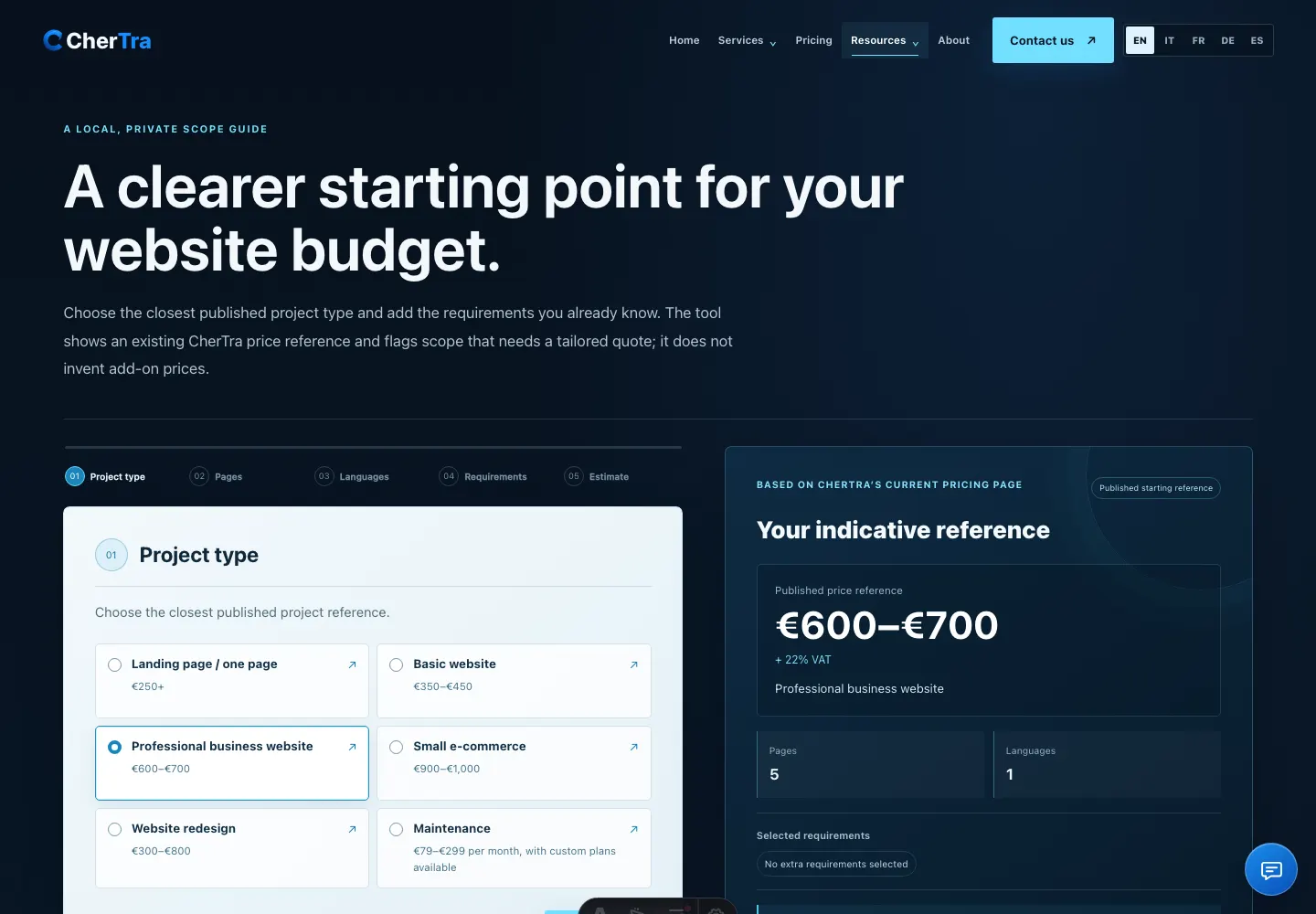
The website cost estimator is a browser-side scope guide, not a quote generator. Its visible price references come from the shared pricing configuration. Visitors select a project type, page and language counts, and possible requirements; the page compares those inputs with published references and flags scope that needs a tailored review.
The current implementation does not send or store the estimator answers. It does not invent add-on prices or promise that a project can be delivered at the displayed starting point. The final scope and tax treatment remain subject to a written proposal.
Open the website cost estimator04
What is verifiable in this implementation
- The repository configures Astro for static output and defines five supported site locales.
- The current News data contains 49 underlying stories with EN, IT, FR, DE and ES routes.
- The estimator uses the shared pricing data, performs its calculation in the browser and states that answers are not sent or stored.
- The build and static SEO audit can verify generated routes, canonicals, hreflang, sitemap coverage and internal locale links.
05
Limitations and what this case study does not claim
- This is CherTra’s own website, not independent client work. It provides no evidence of client satisfaction, commercial conversion, revenue growth, search ranking gains or measured performance improvements.
- Static generation means content changes require a new build and publication. Dynamic features such as the estimator still need browser JavaScript; its static HTML alone does not demonstrate every interactive state.
- Automated route and metadata audits cannot replace native-language editorial review, accessibility testing with assistive technology, or real-user performance measurement.